Long before “sustainability” was a buzzword, Jack was already doing the unglamorous, foundational work of it — sorting trash by hand to prove it had value. In the 1980s, as part of the West Virginia Economic Regeneration Project, he led a scrappy recycling effort in Morgantown that started with a $10,000 contest prize, a used truck with a hydraulic lift, and scavenged steel barrels. It’s the kind of origin story that sounds almost like a garage startup — except the product was properly disposed discards, and the return on investment was a cleaner county. That effort grew into “We Recycle,” a program with real employees, real routes, and profit-sharing built in from the start, and it eventually anchored a 5,000-square-foot recycling center next to Morgantown’s old city incinerator — a nice bit of symbolism, a recycling operation literally standing in the shadow of the burn plant it was meant to make obsolete.
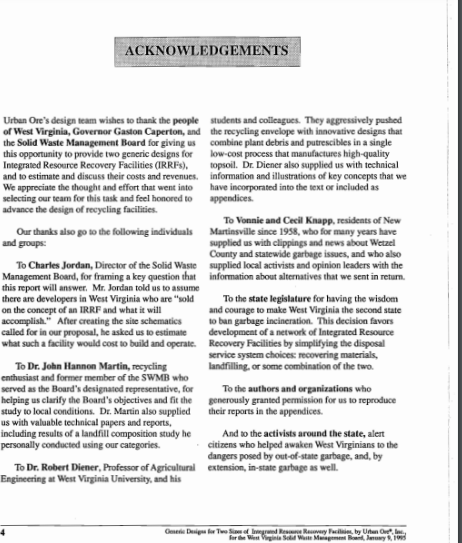
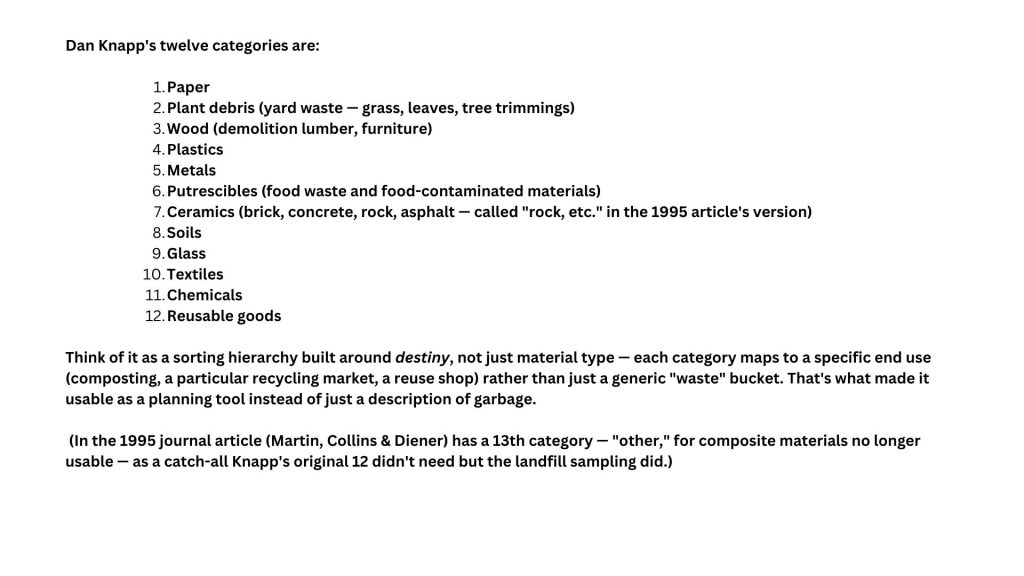
The Urban Ore report to the West Virginia Solid Waste Management Board (the “Integrated Resource Recovery Facilities” report) and the 1995 Journal of the Air & Waste Management Association article (links on this page) both sit downstream of the same insight Jack helped develop: that you can’t manage what you haven’t measured. His doctoral dissertation built a standardized protocol for sampling and categorizing municipal solid waste using Dan Knapp’s twelve-category framework — the same framework at the center of both documents. That protocol is the technical article’s entire subject, and it’s also the data backbone the Urban Ore report leans on to design the 25-ton and 100-ton-per-day IRRF facilities for the state.
It’s worth noting how much of a convergence moment this was for Jack. He met Dan Knapp at a WV DEP conference, then teamed up with Dr. Robert Diener at WVU — and the three threads (Knapp’s categories, Diener’s engineering, and Jack’s own field-tested protocol from “We Recycle” and “We Compost”) braided together into something bigger than any one of them: a template that didn’t just serve West Virginia but Jack traveled internationally, sharing the work in a conference in Canada and a USAID training program for Romania, Slovakia, the Czech Republic, and Poland. From there the throughline runs straight to his later work certifying compost trainers nationally, and then to nearly three decades teaching Sustainable Resource Management at Appalachian State, where he rebuilt the recycling and composting programs from the ground up — the same instincts he had with that first used truck, just with a classroom attached.
In the early 1990s, Jack was at at conference at Eagle Rock, Georgia where he coined the term, “Zero Waste.” A term that has caught on. (Jack and colleagues were in Georgia to protest Coca-Cola’s broken promise to use recycled materials in the manufacturing of their bottles.)